
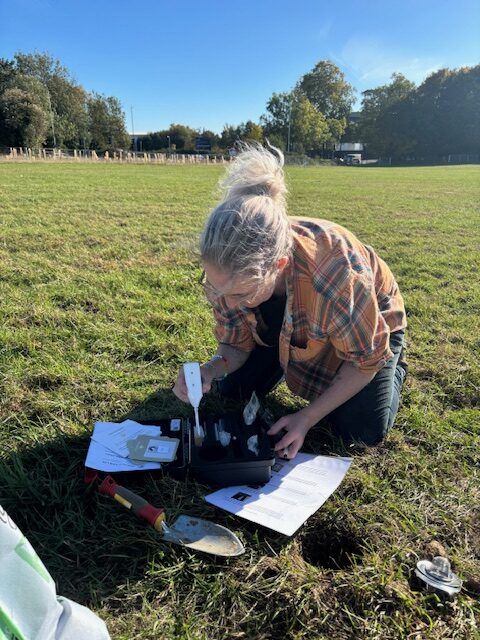
Recently, the Soil Association team was at Woodoaks Farm in Hertfordshire, England collecting soil samples as part of the AI 4 Soil Health project (AI4SH). Madeleine Silberberg, Project Coordinator, coordinates 13 pilot sites across the continent in partnership with leading European institutions. These sites, covering 11 pedoclimatic regions, were selected based on distinctive soil qualities. The team are using advanced measurement techniques, generating new insights into the health of Europe’s soils, testing the assumptions in their models, and helping determine the best monitoring tools for the future.
Soil Association Farming Advisor, Karen Fisher, shares her experience using microBIOMETER® on this project.
“microBIOMETER® turned out to be a genuinely exciting addition to the toolkit. The first test took me a little while, carefully following the instructions step by step, but once I got into the rhythm the process was surprisingly straightforward. The longest part was waiting for the sample to develop but that slotted in nicely while we collected bulk density samples and soils for lab analysis.
I did have a small hiccup with scanning the first card, but I think my app might have been on the wrong mode, but after that everything worked perfectly. Each scan felt a bit like opening a present. I found myself looking forward to seeing what the next result would show.
It was fascinating to see the different patterns emerging across woodland, permanent grassland, conservation fields and compost. Some results weren’t quite what you might expect, for example, a woodland showing a lower fungal: bacterial ratio than a long-term grass field. It is a reminder that context matters: soil biology reflects both current conditions and land use history, and sometimes regeneration takes time.
These kinds of rapid, field-based tools do not replace lab analysis, but they bring soil life into focus in a way that is both practical and accessible. Over time, repeating these tests across seasons and management practices will help us build a richer picture of soil health and feed into the development of different indicators.”
Senior Farming Advisor Josiah Judson, “‘It was great to be out in the field making sure the tools we’re developing actually make sense on the ground and can support different users. It’s an ambitious goal to map these things across so many different landscapes, but the more data we can get, the better!”
 Ithaca Central High School science teacher Robert Tuori is conducting a study to examine short term changes in soil health at Nook And Cranny Farm, a diverse vegetable farm, as an independent research project for the USDA Climate Change Adaptation and Mitigation Fellows.
Utilizing both the microBIOMETER® and Cornell Soil Health Assessment, Robert and students will compare tilled vs non-tilled soil in 4 crop beds, each containing either brassica or cucurbit, and flipping crops midseason. The beds were covered in October of last year with a cocktail of winter rye, vetch, and triticale. These cover crops were grown until early May, then covered with a black silage tarp for one month. The brassicas were planted into hay mulch while the cucurbits were planted into biodegradable plastic mulch.
Robert is particularly interested in looking at easy, on-farm testing, as well as lab analysis. They will conduct microBIOMETER® testing on each bed three times throughout the season: before planting, midseason before second planting, and at the end of the season. For the lab based analysis, they will measure nutrient levels in each bed at the beginning and at the end of the study, as well as perform the Cornell Soil Health Assessment on all four beds at the end of the study.