
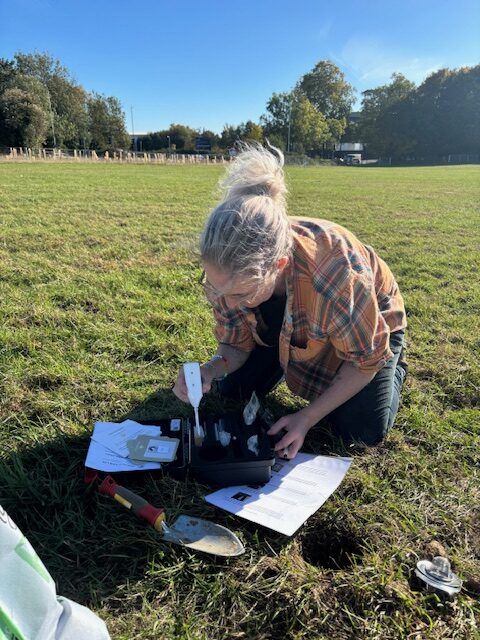
Recently, the Soil Association team was at Woodoaks Farm in Hertfordshire, England collecting soil samples as part of the AI 4 Soil Health project (AI4SH). Madeleine Silberberg, Project Coordinator, coordinates 13 pilot sites across the continent in partnership with leading European institutions. These sites, covering 11 pedoclimatic regions, were selected based on distinctive soil qualities. The team are using advanced measurement techniques, generating new insights into the health of Europe’s soils, testing the assumptions in their models, and helping determine the best monitoring tools for the future.
Soil Association Farming Advisor, Karen Fisher, shares her experience using microBIOMETER® on this project.
“microBIOMETER® turned out to be a genuinely exciting addition to the toolkit. The first test took me a little while, carefully following the instructions step by step, but once I got into the rhythm the process was surprisingly straightforward. The longest part was waiting for the sample to develop but that slotted in nicely while we collected bulk density samples and soils for lab analysis.
I did have a small hiccup with scanning the first card, but I think my app might have been on the wrong mode, but after that everything worked perfectly. Each scan felt a bit like opening a present. I found myself looking forward to seeing what the next result would show.
It was fascinating to see the different patterns emerging across woodland, permanent grassland, conservation fields and compost. Some results weren’t quite what you might expect, for example, a woodland showing a lower fungal: bacterial ratio than a long-term grass field. It is a reminder that context matters: soil biology reflects both current conditions and land use history, and sometimes regeneration takes time.
These kinds of rapid, field-based tools do not replace lab analysis, but they bring soil life into focus in a way that is both practical and accessible. Over time, repeating these tests across seasons and management practices will help us build a richer picture of soil health and feed into the development of different indicators.”
Senior Farming Advisor Josiah Judson, “‘It was great to be out in the field making sure the tools we’re developing actually make sense on the ground and can support different users. It’s an ambitious goal to map these things across so many different landscapes, but the more data we can get, the better!”

Bucknell University is a private liberal arts college in Lewisburg, Pennsylvania with excellent research facilities and innovative teaching. Students get the opportunity to work closely with professors in their chosen field.
Students in the Biology 203, Integrative Concepts in Biology, laboratory have a unit all about soil. The students visit the Bucknell Farm to learn about the properties of healthy soil. They then pick a location on campus to study. Students study the health of the soil in different conditions, such as soil with native flowers growing compared to soil under a tree. They measure microbial biomass, soil respiration rate, and various other soil properties to determine the overall health of the soil.
“The microBIOMETER® test allows students to quickly and easily measure microbial biomass and the relative amounts of bacteria and fungi in the soil. It is easy to use for non-experts with very quick results! We have measured huge differences in the microbial biomass at locations across Bucknell’s campus and have been surprised to have very high levels of biomass in the grassy areas, too!” – Rebekah Stevenson, Director of Core Course Laboratories – Biology Department


Founded in 2003 UK based Wildflower Turf Ltd has pioneered and developed a soil-less growing system which has transformed the concept of turf growing.
Working with soils a fair bit, it being the substrate into which their products are grown, they are interested in understanding the relationship between plants and soil. This involves investigating things such as soil structure, nutrient content, and more recently microbial content, at their R&D testing facilities in Hampshire.

Bright Endeavors Now classroom
Bright Endeavors Now (BEN) located in Tanzania, East Africa was started by Biology professor Dr. Regina Herbert, PhD and her husband, an Electrical Engineer, Ricardo R. Herbert, MUP, MBA.
The BEN program provides an environment where budding engineers, designers, scientists and doctors are introduced to concepts in the sciences, technology, engineering, art and math (STEAM), through engaging, developmentally-appropriate activities. Preschool, weekday, weekend and summer programs for children ages 3 to 16 are offered. BEN aspires to travel around the globe providing STEAM education.
Recently, microBIOMETER® was utilized as part of the “Soil and Microorganisms” series in their multi-age science class with students aged 3 to 15. Earlier in the school year, the students established Winogradsky Columns to observe microbial communities. The students then tested the soil with microBIOMETER® to see how specific ratios of fungi and bacteria can have an impact on soil health. In addition, it helped lead to a discussion on how different types of soil can have different ratios which can have an impact on how they grow plants and crops.
We love the microBIOMETER® soil test kit and will continue to test different samples with students as we travel to the US.” – Regina Herbert
 Janet Atandi, a nematology PhD student in Kenya, is currently working on an assessment of banana fiber paper on soil health as part of a Wrap and Plant technology study. In brief, she is testing the long-term effect of using modified banana fiber paper to manage plant-parasitic nematodes and its impact on the beneficial soil microbial communities.
The banana fiber paper is used as an organic carrier for either ultra-low dosages of nematicides (abamectin and fluopyram) or microbial antagonists (Trichoderma spp.) and is to be compared to unmodified paper.
This study is being conducted using potatoes and green peas as the test crops over five consecutive seasons. With the aid of a microBIOMETER® test kit, Janet will be able to assess the impact of the paper on the soil microbial biomass and thus will be able to determine whether the banana paper is effective or detrimental to soil health.
Wrap and Plant technology sources:
NC State explores promising pest-control strategy with high-impact potential for sub-Saharan Africa
Banana’s Waste, potatoes gain
Potato farmers conquer a devastating worm—with paper made from bananas]

University study demonstrates legumes are more efficient at improving soil MBC than grasses
Under the direction of Assistant Professor Denise Finney, Kylie Cherneskie, biology student at Ursinus College, conducted an experiment on the impacts of nitrogen fertilizer addition on soil microbial communities. Kylie measured microbial responses using microBIOMETER®.
Click here to view the finished poster presentation. If you would like to incorporate microBIOMETER® into your classroom studies/academic research, we offer a selection of Academia Classroom Kits.

Austin Arrington of the Plant Group
Austin Arrington of Plant Group NYC performed a research study on hemp’s capacity to sequester carbon. Austin utilized microBIOMETER® in this research. We originally had the pleasure of meeting Austin through Indigo Ag’s Terraton Challenge. Plant Group is a fellow semi-finalist and alumni.
Hemp has the promise of being a twofer: a financially successful crop as well as a carbon crop that increases soil carbon for carbon credits and increased fertility. Austin used microBIOMETER® to evaluate two organic fertilizer regimens for a hemp crop; an early fertilization during the vegetative phase and a month later during the flowering phase.
Honeysuckle Hemp 2021: Research Notes
One hectare of industrial hemp can absorb up to 22 tonnes of CO2 per hectare. The fact that industrial hemp has been proven to absorb more CO2 per hectare than any forest or commercial crop makes it an ideal tool for carbon farming (Vosper, 2011).
Two acres were hand seeded with Maya hemp grain on 05/23/21 in a silt clay loam soil in Council Bluffs, IA. Prior to tilling (with a rear tine tiller) and seeding with hemp the area was covered with white clover. The area was split into two zones that each received organic fertilizer at different times. The Early Fertilizer Zone was fertilized on 07/25/21. The Late Fertilizer Zone was fertilized on 08/08/21. Mega Green (2-3-2), the organic fertilizer applied for the study is derived from squid waste and was diluted with water for application across the field.
The microBIOMETER® spectroscopic tool was used to estimate microbial biomass carbon and fungal to bacterial ratio. Microbial biomass carbon is a measure of the carbon ( C ) contained within the living component of soil organic matter (i.e. bacteria and fungi). Microbes decompose soil organic matter (SOM) releasing carbon dioxide and plant available nutrients. The measurement unit of the device is ug C / g (micrograms microbial biomass carbon). Click here to read full study.

Nature article reports that microbial biomass estimates by microBIOMETER® correlates with soil health and yield stability.
The microBIOMETER® soil test was used to report microbial biomass in a recent Nature publication*. Scientists Dr. Judith Fitzpatrick and Dr. Brady Trexler of microBIOMETER® collaborated with a University of Tennessee team headed by Dr. Amin Nouri. The team evaluated the effects on soil health and yield stability of 39 different methods of raising cotton over 29 years. The conditions tested included till, no-till, various cover crops and different levels of nitrogen fertilization.
The study found that the major impacts on yield were very dry or wet conditions, and low or high temperatures. The deleterious effects of these weather extremes on yield were mitigated by regenerative agricultural practices which resulted in adequate soil, C, N, soil structure and microbial biomass.
*Nouri, A., Yoder, D.C., Raji, M., Ceylan, S., Jagadamma, S., Lee, J., Walker, F.R., Yin, X., Fitzpatrick, J., Trexler, B. and Arelli, P., 2021. Conservation agriculture increases the soil resilience and cotton yield stability in climate extremes of the southeast US. Communications Earth & Environment, 2(1), pp.1-12.
 The Biospheres, working through the CDA*, accompanies and trains farmers/agricultural companies in the agroecological transition based on a soil conservation approach. The group is also working on applied research projects and therefore on trials under real farming conditions in which they evaluate the impact of certain changes in practices on different indicators (biological, chemical, physical, economic).
“One of our primary objectives is that farmers succeed in putting biology back into their soils to ensure their natural fertility. We are therefore very interested in everything that lives in the soil, from earthworms and microarthropods to microorganisms (bacteria, fungi, nematodes). For us, microbial biomass is one of the most important indicators that help us understand soil biology. Fungal to bacterial ratio, which is a less documented indicator for the moment, remains interesting to observe in certain situations and is the object of real research by our R&D team to understand how best to interpret it.
We have been using microBIOMETER® for 8 months now to test the soil in different projects in our panel of biological indicators. microBIOMETER® provides us with quick and easy results on microbial biomass and F:B ratio which is a real plus for us. We can perform tests directly in the field and present the results to the farmers. Moreover, the affordable price of the analysis allows us to perform soil biology tests in projects where we had no affordable way to do so before.”
*CDA, Centre de Développement de l’Agroécologie, are affiliates dedicated to R&D and advisory.


University of Louisiana at Lafayette
Last semester Soil Science and Environmental Pedology students under a supervision of Dr. Anna Paltseva [annapaltseva.com] conducted a soil microbial experiment on campus of University of Louisiana at Lafayette. First, each of the group of students collected different samples. Samples were collected from lawn, vegetable containers, around tree pits, and a native plants garden. The soil samples were analyzed in accordance with the provided procedure, which is simple and fast. The microBIOMETER® app tested the samples and gave each of the readings. The readings were in microbial biomass expressed in microbial-carbon per gram of soil (ug/g) and fungal to bacteria ratio F:B, F% and B%.
The vegetable container and samples from the tree pits showed the highest range of 400 – 800 ug/g. This is due to high organic matter content. The low results from the lawns may have been due to limited microbiological diversity due to monoculture of grasses grown. The areas close to the water bodies (culvert, pond, etc.) may have been lower due to organic matter washing away over time. All the samples were predominantly rich in bacterial population over fungal.
“microBIOMETER® is a very efficient and time saving tool. It can be used by scientists, farmers, or a gardener in learning the microbial health of their soil. This testing process is also very non-invasive, and thus having a lesser negative environmental impact compared to traditional testing. One of the students said, It was pretty cool using an app to analyze soil. I want to know how it works since it all felt like magic.” – Dr. Anna Paltseva
Click here to view the student’s video.
Order a microBIOMETER® Academia Kit for soil testing in your classroom!
If you are interested in Dr. Paltseva’s research or would like to learn more about urban soils, please follow her on Instagram.

Microbial Biomass Chart