

You’ve probably read how important it is for your soil to have a large, diverse microbial population, but how do you know that all those microbes are good?
Well to start, a healthy and optimal microbial population in your soil will always have a mixture of good and bad microbes. Together, these microbes perform important tasks to keep the soil functioning and the plants flourishing. Despite the complex relationship between plant and soil microbes, research suggests that soil microbes play a significant role in nutrient cycling, structuring plant communities, influencing plant performance and growth, and in disease control, which is why it’s so important to have a dense and diverse microbial community.
Thankfully, these soil microbe-plant interactions are self-regulated. And to keep these microbes functioning and plants thriving as they should, there’s a system of checks and balances that occurs within soil. For example, in a healthy, diverse soil mixture, microbes help plants suppress pathogens by inducing natural plant defenses, producing antibiotics, fighting against pathogens, or through the hyperparasitism of the pathogen. However, when there is an influx of pathogens in a not-so-healthy and diverse soil, things will start to function differently.
Once there’s a large enough influx of pathogenic microbes that have colonized within the soil, these microbes will produce chemical signals called autoinducers, which regulate microbial gene expression in a process called quorum sensing. In this example, quorum sensing allows those microbes to communicate with each other and change their genes to become virulent. Soil can become more susceptible to virulent factors if there isn’t adequate microbial diversity, as a diverse microbial community is critical to maintain ecological processes. To mitigate the negative aspects of quorum sensing, it’s imperative to have a diverse vegetation aboveground and a diverse microbial community belowground.
However, despite the good microbes’ best effort, soil conditions change and sometimes pathogens can take control. Depending on the pathogen, different physical signs and symptoms will become evident on the plant. Common signs of pathogenic disease on a plant can include foliage wilting, stunting, browning, and yellowing. Fortunately, because these are all aboveground symptoms, diseases can be easier to identify and potentially treat. Though, there are common belowground pathogens that affect the root systems of plants. These are more difficult to diagnose as they don’t always produce physical signs on the plant. The only way to specifically identify the pathogenic microbial species within your soil is to send your soil’s DNA to a lab for further analysis.
The best method that researchers have found to combat these soil pathogens is by supporting the good microbes, as the best defense is a good offense. Because microbial diversity has an almost linear relationship to microbial biomass, increasing the soil’s microbial biomass will increase its microbial diversity, which is the key to having a functioning and thriving ecosystem.
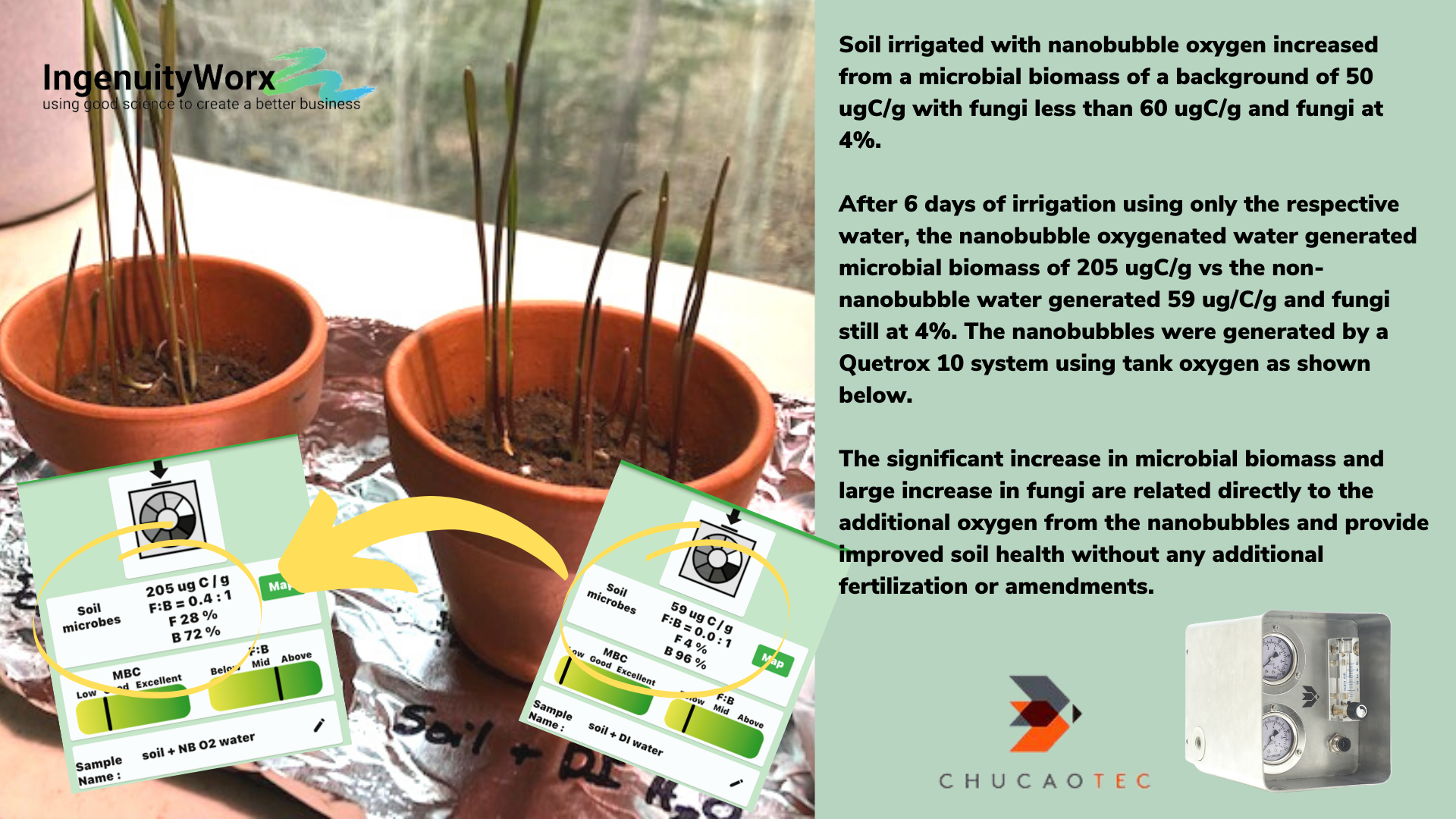
IngenuityWorx has been working to prove that the application of nanobubble oxygen as an irrigation/fertigation tool can provide low cost, easily applied plant benefits both indoors and outdoors.
It has been known for over 40 years that increased oxygen to plant roots in soil improves nutrient absorption, reduces effects of saline water or sodic soils, and increases plant growth and yields. However, traditional aeration technology prevented its use. Aerated water was limited to very short application duration and limited travel time in an irrigation line with low oxygen transfer efficiency.
The new science of nanobubbles allows us to add high dissolved oxygen concentrations, reaching 30-50 ppm, and the oxygen transfer will continue to take place for weeks. The nanobubbles don’t coalesce and break like macro bubbles, they move within the water using Brownian motion, and upon giving up all their oxygen produce small amounts of reactive oxygen species including hydrogen peroxide. This feature provides a built-in cleaning process that removes biofilm.
The microBIOMETER® analysis here shows that high dissolved oxygen in the irrigation water stimulated the microbial biomass and fungi to increase in number indicating a healthy microbiome in the soil for plant growth.
Additional work is ongoing to measure and understand the effects of the oxygenated water and microbial increases as it relates to soil carbon utilization, and its impact on carbon reserves and available nutrients. For more information, please contact bo*@***********rx.com.

Effects of Herbicides on Soil
Working with students to help them better understand the complexities of soil as well as fuel their passion for the life underground has always been one of the primary goals of our company. These young minds are vital to the future of our planet.
Recently, we had the pleasure of working with Emaan Ashfaq, a ninth grader at Ashfaq Homeschool. Emaan performed a science project titled Effects of Herbicides on the Soil. The project used microBIOMETER® to analyze the impact of glyphosate and natural weed killer on the soil’s fungal to bacterial ratio.
Emaan presented the project at the Pittsburgh Regional Science Fair and placed 3rd in the Earth and Environment category. Congratulations, Emaan!
If you would like to utilize microBIOMETER® in your science fair project please contact us!
 An interview with the San Antonio Food Bank who is using microBIOMETER® in their Farm and Garden Program.
How are you using microBIOMETER®?
We are using microBIOMETER to track the soil health on our farms, gardens and compost. This test allows us to understand if we are providing an environment for our crops to thrive. Because we grow fruit trees, herbs and annual edible crops the fungal to bacterial ratio helps us identify the current soil health and help us understand what strategies we can look to implement to improve that environment over time.
How does microBIOMETER® help people understand the importance of soil biology as opposed to the historical focus on soil chemistry?
Traditional soil tests give you a window into what nutrients are or are not available within your soil. It can give you insight into how much organic matter might be present in your soil, but not how you might work to track progress on soil health, diversity or improving your soil food web on an affordable level. While knowing the nutrient breakdown is helpful information it does not help you understand if you are providing an ideal environment for those micro and macro organisms to thrive and ultimately aid your crops or plants in receiving those nutrients and so much more. The microBIOMETER® test kit has helped us better understand our complex food web and what strategies we can do to create a more balanced environment for our crops and our soil.
How did the microBIOMETER® information assist you with your project?
This test helps us to educate not only our staff on soil health strategies, but also our volunteers and anyone who attends are Teaching Garden classes. The data we collect helps us to showcase how the strategies we are employing to improve our soil health are making a difference from season to season as opposed to every two years from a traditional soil test. That enables us to make better recommendations to our community of growers about ways they can improve their soil, too.

About the San Antonio Food Bank
The San Antonio Food Bank takes pride in fighting hunger, feeding hope in our 29-county service area. We believe that no child should go to bed hungry, adults should not have to choose between a hot meal and utilities, nor a senior sacrifice medical care for the sake of a meal.
Founded in 1980, The San Antonio Food Bank has quickly grown to serve 90,000 individuals a week in one of the largest service areas in Texas. Our focus is for clients to have food for today but to also have the resources to be self-sufficient in the future.
Fighting hunger is our number one priority but we also serve to educate and provide assistance in many other ways. We achieve this through our variety of programs and resources available to families, individuals, seniors, children, and military members in need.
Our Farm and Garden Program consists of two locations and six growing spaces, including two farms and the garden at the New Braunfels Food Bank. Together these areas total more than 100 acres and provide 300,000 pounds of fresh local produce annually to our 29-county service area. We utilize 5,000 volunteers annually to assist with our operation and to provide local produce to the community.
Our Farm and Garden Program strives to provide quality, local produce to the community and to provide resources to teach those in our community how to grow food for today and in the future. In order to meet those goals, we start with our soil. By understanding our soil biology and health we get a window into what is happening at the root level and better understand the environment where our crops live and how to make improvements so we are growing healthy plants and nutritious crops. We believe everyone deserves access to nutritious fruits and vegetables.
Our Teaching Garden classes provide information about the importance of soil and composting as a foundation for building soil diversity and health. We utilize cover cropping on the farms and in our gardens to reduce erosion, build soil fertility, reduce weed pressure and increase organic matter. We create and utilize composting to increase the diversity of our soil, divert valuable resources from the landfill and introduce the community to the benefits of composting at home or in the community.

Zack Shier, Joseph Tree Service
Effects of Humate and Organic Based Soil Treatments on Urban Soil Characteristics
Zack Shier, Board Certified Master Arborist and Plant Health Care Manager at Joseph Tree Service, is utilizing microBIOMETER® in his study titled Effects of Humate and Organic Based Soil Treatments on Urban Soil Characteristics.
Introduction to the study. Urban soils have long plagued tree care providers with a difficult obstacle to tree health optimization. The very nature of how our urban soils come to be makes it quite challenging to diagnose the major issues with our soils, let alone correct those issues consistently, and with enough efficiency to make it affordable to clients.
When buildings or homes are built in our cities and towns, the natural layout and structure of soils is heavily modified, and often changed in erratic ways. Large holes are dug, bringing soil horizons meant for the deep areas, to the surface; mixing heavily with surface horizons. The top O and A soil horizons are often scraped clean to level surfaces, moving them or completely taking them away. Outside products, like “clean-fill” are often brought in, adding foreign soil or even rock (like quarry, limestone fill) into the surface soil area.
On top of this sub-par growing medium we’ve created, we also plant turf or put asphalt and concrete into most of the area. We then rake up and get rid of all organic litter and material, continually robbing the soil of the reincorporation of organic matter that forests are accustomed to. To add to the problem, urban trees are grown quickly using synthetic fertilizers on tree farms, and then dug up to be planted, cutting anywhere between 50-90% of their roots off, and often planted in different soil than they were grown in.
This entire predicament creates poor chemical, physical, and biological soil characteristics, resulting in poor urban tree growth, increased insect and disease populations, and high rates of nutrient deficiencies. (Read more)
 This article was provided to us by Scott Hortop, a retired volunteer and now student of soil, located in the Ottawa Valley, Ontario, Canada. Scott wants to use his retirement to do one important thing for the climate.
At ONfungi we own two microBIOMETER® soil testing kits which we use to determine the fungal to bacterial ratio (F:B) of the Johnson-Su fungal dominant compost (FDC). The ONfungi group makes FDC from tree leaves.
We are excited by the potential of leaf mold to:
• Reduce agricultural dependence on external inputs
• Divert leaf organics from landfills
• Replenish the inventory of carbon in the soil by drawing down the carbon in the atmosphere
• Grow knowledge about working with mother nature to address climate change
Our first FDC bioreactor batch was started in Spring 2018. Since then, we have put up a total of 15 batches; 8 of them in fall 2021.
“It took us 3 batches before we faced the fact that we needed to know whether what we were producing was actually what we hoped it was. Our enthusiasm needed to be grounded. What is the fungal bacteria (F:B) ratio in our FDC?,” says Scott Hortop, wizard of compost for the ONfungi group. “This is why we have found the microBIOMETER® to be our most useful tool.”
“Dr. David Johnson’s talks have shown us eloquently how the F:B ratio is the most meaningful indicator for soil health”, Hortop explains. “As we share our fungal dominant compost (FDC) with other users, we owe them a solid measure of what they are getting. When we and others share our FDC experiments with each other at the Chico State University Registry of Johnson-Su Bioreactors, the majority of us have been unable to report F:B ratios. This has now changed. With the microBIOMETER® we can confirm that we have the right ratio of ingredients by taking a real measure of the F:B ratio.”
Its All Relative – Isn’t it the change and the direction of changes that we really need to know? Of course, it might be nice to think every microbe was identified and counted under a microscope, but that precision comes at a HUGE cost and most likely doesn’t alter the conclusion. The next thing we need to do to strengthen the microbial community.
Immediacy – When you are checking in on living microbes in soil, some of whom are reproducing and dying in a matter of minutes and others taking years, the best timing for a test is here and now. In a world rich with distraction and delay, its awesome to get a result from your testing efforts immediately.
True Cost Per Data Point – For the purpose of our bioreactors, give it a think: the modest variable costs per test, the modest labour to execute a test which is just minutes beyond the time required for sample collection, the VERY efficient and effective recording of results, and the $0 sample shipping cost.
 In an ONfungi citizen science trial last summer by one of our volunteers in White Lake, Ontario, 2 sunflower seeds were planted in late June into moderately degraded farmland (microBIOMETER® F:B 0.7:1; 464 µg C/g).
The control seed (left) received no soil amendments. The 2nd seed (right) was planted with 50 grams (a small handful) of Johnson-Su fungal dominant compost (microBIOMETER® F:B 1.7:1; 700 µg C/g) surrounding the seed. For 8 weeks both plants received identical, adequate watering. The 8-week photo below shows the control sunflower on the left suffering from an invasion of cucumber beetles with less than ½ the height and 1/3 the stalk width compared to the sunflower on the right with FDC at its root zone. Although beetles were observed on the FDC sunflower, some disease resistance was evident.
One of ONfungi’s targets this year is to do monthly tests on completed FDC material to chart the staying power and degradation curve of finished FDC, not yet put to use and in several storage modes. We are also using the microBIOMETER® to look at carbon sequestration in lawn soils.
About ONfungi; ONfungi is a happy conglomeration of active volunteer folks. Their goal is to explore, through citizen science, the use of Johnson-Su fungal dominant compost (FDC) in improving soil, storing carbon, and enhancing plant health and nutrition. Learn more at ONfungi.net

microBIOMETER® can tell you if you are increasing the nutrient value and disease resistance of your crop.
A Rodale study showed greatly increased levels of the vitamins and minerals in sustainably farmed soils as opposed to mineral fertilized crops. And at Rodale, the sustainable practice yields are the same as the paired fields farmed with mineral fertilizers – and in bad weather, and disease years significantly better. Rodale is only one of many studies showing the increased nutrient value of organically and sustainably grown food.
Now Dr. Montgomery of the University of Washington’s team in a similar study has shown that if you are increasing your microbial biomass you are increasing the nutrient level of your crop: “soil health is a more pertinent metric for assessing the impact of farming practices on the nutrient composition of crops”.
Biklé, A. and Montgomery, D.R., 2021. Soil health and nutrient density: beyond organic vs. conventional farming. Frontiers in Sustainable Food Systems.
Hepperly, P.R., Omondi, E. and Seidel, R., 2018. Soil regeneration increases crop nutrients, antioxidants and adaptive responses. MOJ Food Process Technol, 6(2), pp.196-203.

University study demonstrates legumes are more efficient at improving soil MBC than grasses
Under the direction of Assistant Professor Denise Finney, Kylie Cherneskie, biology student at Ursinus College, conducted an experiment on the impacts of nitrogen fertilizer addition on soil microbial communities. Kylie measured microbial responses using microBIOMETER®.
Click here to view the finished poster presentation. If you would like to incorporate microBIOMETER® into your classroom studies/academic research, we offer a selection of Academia Classroom Kits.
 Calibration of microBIOMETER® to units of µg microbial carbon / gram soil
The gold standard of laboratory soil microbial biomass testing is Chloroform Fumigation and Extraction (CFE). The multiple steps, time, and labor involved with CFE require pricing at up to $500 per sample. CFE works by comparing the difference of chemically extractable carbon between two portions of a soil sample: One that has been treated to break open microbial cell membranes and expose the carbon-containing biological molecules to extraction, and one that has not. The difference in carbon for the two portions is reported as microbial biomass carbon (MBC), in units of µg C / g soil.
microBIOMETER® is calibrated to the same units by a different method. Estimates of bacterial dry mass converge at around one trillionth (1×10-12) of a gram (1 pg) for a 1 µm bacterium. We measured the area of microbes in known volumes of microBIOMETER® extract (both by manual counting on a hemocytometer and by digital analysis of micrographs) and calculated total microbial mass, which was then converted to µg / g for the whole 0.5 ml sample of soil in the extract. We found that on average, 0.5 ml of soil weighs 0.6 g when fully dried, independent of starting moisture content. The 1 pg dry mass per bacterium is 50% carbon, so we also had to account for that in our calibration.
Here’s an example of the conversion.
Let’s say that in 1×10⁻⁸ liter (10 nl) of microBIOMETER® extract we measured 240 µm2 of microbes. 240 µm2 = 240 bacteria equivalents (BE). 240 BE x 1×10-12 g per BE = 240×10-12 g of dry microbes. The volume of original extract is 10 ml (1 x 10⁻² liter), and 10 nl of microscopically examined extract represents 1×10⁻⁸/1×10-2 = 1×10⁻⁶ of the total mass of the microbes in the extract. So 240×10-12 g microbes / 1×10-6 = 240 x 10-6 g microbes in the whole extract. 50% of the 240 x 10-6 g of microbes is carbon, so we have 120 x 10-6 g microbial carbon. We started with 0.5 ml = 0.6 grams of dried soil in the extraction process, therefore 120 x 10-6 g microbial carbon / 0.6 g soil = 200 x 10-6 g microbial carbon / gram soil, or 200 µg microbial carbon / gram soil.
While we arrived at µg microbial carbon / gram soil through a different method than CFE, it turns out our methods are on par with the CFE test. We compared measurements of µg carbon / gram soil via CFE and microBIOMETER® from 28 soils from across the U.S.
The slope of ~1 of the regression line indicates our units are on par with CFE, and the 94% correlation indicates that users can be confident that the $13.50 or less microBIOMETER® test gives results as accurate and informative as one priced $500.
 Different methods measure different fungal and bacterial populations. The chart below, adapted from Wang et al review of 192 different F:B ratios, illustrates how three different methods came up with three different F:B ratios for Forest, Farmland and Grassland. Note that microBIOMETER® correlates well with the gold standard, microscopy. By plate culture, forest F:B is about 1/3 that of farmland, whereas PLFA forest F:B is slightly higher, and microscopy and microBIOMETER® forest F:B are 10 times higher than farmland.
